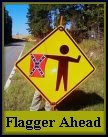
Tiffany Owens, 18, left and Corey Click, 18, right, hold up the school flag outside Allen Central High School in Floyd County. (AP photo/Samira Jafari)
David Hawpe "Be honest. What images did you readers conjure up when you read that an Eastern Kentucky high school was hanging on to its Rebel flag?
A ramshackle building at the head of some creek, where some students ride to school in worn out buses and others in junkers that really should be retired, mercifully, to a final resting place on concrete blocks?"
David Hawpe looks at politics and policy in Kentucky and Southern Indiana, and sometimes at how his garden grows.
His column appears Sundays and Wednesdays in The Forum.
Story
HEREContact:
Email:
dhawpe@courier-journal.com Sound off
HEREDear Sir,You couldn't be more off the mark. You speak in the voice of the Jacobins/Puritans whose ascendancy for over a quarter of a millennium now as resulted in both physical (millions dead in its name) and spiritual (ancient cultures destroyed and distorted) destruction.
Please see the below, sent to the local Floyd County newspapermen and the Floyd County School Superintendent:
Folks,
I'm writing to applaud Allen High's defense of its name and mascot.
My father was a WWII veteran. His father a WWI veteran [and native of Pike County Kentucky]. His younger brothers Korean War vets and his youngest brother was killed in action in Vietnam in 1969 (serving in the unit portrayed in the movie We Were Soldiers). My dad’s great grandfather was Cpl George Washington Childress, 10th Kentucky Cavalry CSA. (There were two black brothers in his regiment and were evidently two of the more proficient Yankee killers in that unit. At least one of them spent time in the hell holes that were northern POW camps. He was there with one of my GG Grandfather’s first cousins, Loving Childress. Like nearly all black Confederate soldiers, he adamantly refused to take the oath of allegiance to the US Govt which would have freed him from that pestiferous place) Cpl Childress’ grandfather was Pleasant Childress, Revolutionary War veteran, buried in Pike County Kentucky. Both were related to Childress boys who fought on the Kings Mountain battlefield (one of whom was mortally wounded) and of which Capt Webb writes in his book cited below.
I would suggest to you that the Warriors of whom Webb writes are what Allen Central High's name honors. I would strongly hope they are successful in their efforts to keep their name.
As the descendant of those kin who have shed blood from the very founding of this country to establish and defend the principles on which it was founded, I only desire to honor and be honest about why such men as fought for the Confederate States of America sacrificed as they did. I would suggest the name of my great great grandfather is a hint – indeed, the Great Seal of the Confederacy is George Washington on horseback and the birthdate of the CSA was George Washington’s birthday. Webb hits that link between the exertions of our Southern forbears dead on target in the chapter I’ve excerpted below.
Basil D. (Bazz) Childress
Lexington, Kentucky
(Also blood kin to the writer of Texas’ Declaration of Independence and the wife of President James Knox Polk)
The below is what Virginia’s new US Senator has to say about Confederate heritage:
Born Fighting- How the Scots-Irish Shaped America
Captain James Webb, USMC (retired)
Excerpts of Chapter 4
Attack and Die
The War………….was not a contest of equals…..The Union outnumbered the Confederacy [in all ‘war fighting’ categories]…but the South was superior to the north in the intensity of its warrior ethic….
That warrior ethic, which would carry the outnumbered and outgunned Confederacy a very long way, came from long traditions of service that had begun so many centuries before in Scotland and the north of Britain. The Confederate battle flag itself was drawn from the St. Andrew’s Cross of Scotland and the unbending spirit of the Southern soldier found its energies in the deeds of the past just as strongly as it looked up to the leaders of the present. These were the direct descendants of William Wallace’s loyal followers of five centuries before, Winston Churchill’s “hard-unyielding spear men who feared nought and, once set in position, had to be killed.”
……Those Confederate soldiers…..had one inspiration that twentieth century America has not credited to them-the rigorous Revolutionary [War] tradition…..Many..Southern soldier told himself the road was no more stony than the one that had carried his father and grandfather at last to Yorktown….
But not only the Revolutionary War spirit drove them. As I wrote of the Scots-Irish tradition in my novel Fields of Fire, the culture even to this day is viscerally fired by “that one continuous linking that had bound father to son from the first wild resolute angry beaten Celt who tromped into the hills rather than bend a knee to Rome two thousand years ago, who would…chew the bark off a tree, fill his belly with wood rather than surrender from starvation and admit defeat to an advancing civilization. That same emotion passing with the blood: a fierce resolution that found itself always in a pitch against death, that somehow, over the centuries came to accept the fight as a birthright, even as some kind of proof of life.
…The Confederate Army rose like a sudden wind out of the little towns and scattered farms of a still unconquered wilderness……….the Great Captains called, as they had at Bannockburn and King’s Mountain, and the able-bodied men were quick to answer……It saw 90 percent of its adult population serve and 70% of those became casualties… [a rate more than twice as great as the north]…..The men of the Confederate Army gave every ounce of courage and loyalty to a leadership they trusted and respected, then laid down their arms in an instant-declining to fight a guerilla war-when that leadership said enough was enough…And….they returned to a devastated land and a military occupation, enduring the bitter humiliation of Reconstruction and an economic alienation from the rest of the country that continued for a full century, affecting white and black alike.
…..The Civil War, we are taught, was about slavery, ….the Union on the side of God and the angels……..The Union Army, we are reminded again and again even in these modern times, marche to a “Battle Hymn,” ‘As He died to make men holy, Let us fight to make men free, His truth is marching on…..’
By implication, the soldiers of the Confederacy were with the forces of darkness and evil….But the truth is, as always, more turgid, and to understand it one must go to the individual soldier. Why did he fight? ….the odds are overwhelming that he did not own slaves at all………[The Southern soldier] was…one of the world’s very finest fighting man…..
It is impossible to believe that such men would have continued to fight against unnatural odds-and take casualties beyond the level of virtually any other modern army-simply so that 5% of the population who owned slaves could keep them or because they held to a form of racism so virulent that they would rather die than allow the slaves to leave the plantations. Something deeper was motivating them……
….the more learned among these Confederate soldiers, like their political leaders, believed strongly that the Constitution was on their side when they chose to dissolve their relations with the Union…….the states that joined the Union after the Revolution considered themselves independent political entities…….and in their view the states had thus retained their right to dissolve the federal relationship…
This argument was best articulated by Alexander Stephens, Vice President of the Confederacy. Vernon Louis Parrington,….actually supported the constitutional validity of Stephen’s views………..[he summarized Stephen’s argument]: “that state governments existed prior to the Union, that it was jealously guarded at the making of the Constitution, that it had never been surrendered, and hence was the constitutional order until destroyed by the Civil War.”
In a fourteen-hundred page document that the Illinois born, Kansas-raised, Harvard educated Parrington characterized as “wholly convincing,” Stephens laid out the South’s view that the constitutional compact was terminable. Parrington went on to comment that, “Stephens rightly insisted that slavery was only the immediate causus belli. The deeper cause was the antagonistic conceptions of the theory and functions of the political state [that emerged between the sections].
…..the Confederate soldier fought because, on the one hand, in his view he was provoked, intimidated, and ultimately invaded, and, on the other, his leaders had convinced him that his was a war of independence in the same sense as the Revolutionary War…..This was not so much a learned response to historical events as it was a cultural approach that had been refined by centuries of similar experiences. The tendency to resist outside aggression was bred deeply into every heart—and still is today.
Rome conquered Britain and tried to subjugate its people, but the “brave and proud” fell back to the mountains of what later became Cornwall, Wales, and especially Scotland. King Edward marched into Scotland to subjugate its people, but he was resisted and ultimately expelled…..The British sent an expedition into Appalachian Mountains to punish and lay waste to whole communities not supporting the Crown, and their predictable reward was to be stalked, surrounded, and slaughtered. And now a federal government, whose leadership and economic systems were dominated by English-American businessmen and intellectuals, was sending armies to compel them to remain inside a political system that their leaders had told them they had every right to reject.
[In honoring the Confederate soldier we do not honor slavery] we honor courage, as well as loss…[and devotion to the call of duty]….The lesson regarding the [deaths of so many Southern fighting men]….is far more complex than those who simplify his service into racial slogans wish to make it. He and his fellow soldiers took an oath and then honored the judgment of their leaders, often at great cost. Intellectual analysis of national policy are subject to constant reevaluation by historians as the decades roll by, but duty is a constant. Duty is action, taken after listening to one’s leaders and weighing risk and fear against the powerful draw of obligation to family, community, nation, and the unknown future. We, the progeny who live in that future, were among the intended beneficiaries of those frightful decisions made so long ago. As such, we are also the caretakers of the memory, and the reputation, of those who performed their duty-as they understood it-under circumstances too difficult for us ever to fully comprehend. No one but a fool-or a bigot in their own right-would call on the descendants of those Confederate veterans to forget the sacrifices of those who went before them or argue that they should not be remembered with honor…..[to tar the sacrifices of the Confederate soldier as simple acts of racism, and to reduce the battle flag under which he fought to nothing more than the symbol of a racist heritage, is one of the great blasphemies of our modern age…..]
…..the bulk of the Confederate Army, including most of its leaders, was Scots-Irish while the bulk of the Union Army and its leadership was not…..Confederate generals of Scots-Irish descent dominated the battlefield….Robert E. Lee’s [mother was of Scottish ancestry], and it was widely reported that [Lee] was a direct descendent of Robert the Bruce, the victor at Bannockburn.
The end result was that on the battlefield the Confederacy, whose culture had been shaped by the clannish, leader-worshipping, militaristic Scots-Irish, fought a Celtic war while the Union, whose culture had been most affected by intellectual, mercantile English settlers, fought and entirely different manner. At bottom, the northern army was driven from the top like a machine…..by contrast, the Southern army was a living thing emanating from the spirit of its soldiers - …The Southern Army was run like a family, confronting a human crisis.
One learned commentator professed that, “Southerners lost the war because they were too Celtic and their opponents were too English.” But in actuality the reverse was true. The South lasted for four horrific years with far fewer men, far less equipment, far inferior weapons, and a countryside that was persistently devastated as the Leviathan army worked its way like a steamroller across its landscape. It is fair to say that the Confederate Army endured as long as it did against such enormous odds because it was so wildly and recklessly Celtic that it did not know when to stop fighting. And its opponents pressed steadily on to win, and in its aftermath sowed the seeds for a century of hatred and resistance, because in a sense they were so English that they thought victory on the battlefield was the equivalent of conquering a region—and, more important, a culture.
They were wrong, of course. The end result of this war was not to conquer a culture, although the South as a region would suffer enormously for another 70 years. Instead, the war’s horrendous aftermath drove so many people of Scots-Irish descent outward, to the north and west, that their core values became the very spirit of a large portion of working-class America.
"No other war (Civil War) started so many controversies and for no other do they flourish so vigorously. Every step in the conflict, every major political decision, every campaign, almost every battle, has its own proud set of controversies, and of all the military figures only Lee stands above argument and debate. Recent years, however, have seen a new kind of nastiness emerge in these disputes. Even the venerable Robert E. Lee has taken some vicious hits, as dishonest or misinformed advocates among political interest groups and in academia attempt to twist yesterday’s America into a fantasy that might better serve the political issues of today. The greatest disservice on this count has been the attempt by these revisionist politicians and academics to defame the entire Confederate Army in a move that can only be termed the Nazification of the Confederacy. Often cloaked in the argument over the public display of the Confederate battle flag, the syllogism goes something like this: Slavery was evil. The soldiers of the Confederacy fought for a system that wished to preserve it. Therefore they were evil as well, and any attempt to honor their service is a veiled effort to glorify the cause of slavery.
This blatant use of the race card in order to inflame their political and academic constituencies is a tired, seemingly endless game that is itself perhaps the greatest legacy of the Civil War’s aftermath. But in this case it dishonors hundreds of thousands of men who can defend themselves only through the voices of their descendants."
James Webb - Capt USMC (ret) Vietnam Combat Veteran, Secretary of the Navy for Reagan during the 1980s.
I assert to you, Jim Webb hits the matter squarely. To cave in to demands to rename any of our public buildings, surrenders to those who would perpetuate the lies about the Southern fighting man that have been told for over a century now. The Confederate soldiers gave that last measure (if I may be allowed a Lincolnism) in a still awe inspiring effort to separate themselves from what they believed had become a lawless north.
Those who do not acknowledge same, are either dishonest in their opinions or wholly ignorant of the history of the land in which they reside. May I remind you that Kentucky, Missouri, Tennessee, Arkansas, Virginia, North Carolina and Maryland all declined to secede until Lincoln undertook acts of war, quite contrary to the US Constitution to prevent the “Cotton” States secession. If you doubt that characterization, I suggest you research an Ohio US Congressman named Clement Vallandingham who spelled out to the US Congress in July of 1861 and during the course of the subsequent war, just how illegal Lincoln’s actions were. In fact, the reason the list of States above seceded (or tried to before some of them were prevented - Maryland's legislature was thrown in jail for instance and Kentucky and Missouri were simply "silently" occupied), was precisely because, by so doing, Lincoln was standing in opposition to the principle established in the war against England, whereby we obtained our independence. To wit: paraphrasing Thomas Jefferson in the Declaration of Independence, that a people have the right to choose how they will be governed. (And by the way, the heading of that document is The Unanimous Declaration of the thirteen united [NOT United] States of America). From that point forward they were duty bound to stand with their fathers and grandfathers, who had suffered so much to gain that principle from the English Crown, against those who opposed it, even though those who opposed it then controlled the government established by its gaining.
But those who wish to twist history precisely avoid such honesty. Indeed, the fear of that honesty is precisely why Jefferson Davis was never tried for treason. The Attorney General of the United States advised President Andrew Johnson that trying him would afford him a forum in the US court system to establish that the north had acted unconstitutionally, so they let him go for “humanitarian” reasons. Instead, the alchemy became that the hundreds of thousands of dead had died (not for northern greed and power-lust or to oppose it) but so that the land might have a “new birth of freedom” and to free and make equal former slaves. That of course, was not true (but would require another email to demonstrate to you). What that has meant for Southern opinion and symbols is that they have been quite purposely cast, and dishonestly so, as symbols of slavery and racism. That result of course, requires an acceptance of the north’s explanation of its behavior (which seen in its true light is repugnant) and calls into question the very foundation of the “Lincolnian” version of the federal government. Unfortunately, it plays into the hands of those who are true racists, in that it accepts modern multicultural propaganda that the war was racial and every effort is expended to recast the South’s symbols as "offensive".
The claim that folks are offended by the South’s memory of its history, that history being one of racial oppression, see that history and the living symbols representing it, through that dishonest northern [Jacobin/Marxist] filter. But this view is grossly disingenuous. I attended the funeral in Charleston, South Carolina back in 2004 for the crew of the Confederate States submarine CSS Hunley. The occasion was the simple honoring paid to warriors fighting for their country. I marched in a funeral train of 10,000. The streets were lined for 6 miles with 10 times that number, waving Confederate flags of all sorts, but certainly the Battle Flag predominating. Many were weeping. The black folk waved to us and expressed their welcome. The young black boys saluted us as we passed on the way to the cemetery to lay those Confederate sailors to rest. Their salutes were returned, smartly. There is no need for offense to exist, but we all believe what we’ve been taught and what we have been taught are lies. As Napoleon Bonaparte put it, “History is a fable penned by the victors".
The problem of course, is that we Southerners did what our leaders told us. We laid down our arms and tried to become good (albeit re-defined) Americans. Indeed, Richard Weaver in his Southern Essays, complained that we did that all too well. He remarked, “Of all the lingering evils the South suffered as a result of military defeat, none was graver that the almost total extinction of initiative. Those who marvel that the section has lived so much in memory, ….should recall that for a long period it was denied the right of exercising leadership……” We have therefore, been largely powerless to prevent these lies from gaining credence – but today maintaining those lies is not all that is demanded. Today, the demand is to entirely expunge from memory the truth (by disallowing flag displays, tearing down monuments, re-naming our streets and public buildings etc etc) of that cause for which our ancestors fought. To better understand same, I cite a couple of questions I answered for my daughter in preparation for a paper she wrote on Southern heritage for one of her classes at Belmont University in Nashville.
5) How often in your household growing up was the “Civil War” or the conflict between the North and the South mentioned? Occasionally. It might be helpful to know the context of those occasions. Northern Ohio (specifically the Cleveland area) was called “The Case Western Reserve”. There is a university in Cleveland by that name now. That reserve was land set aside for Massachusett’s Revolutionary War veterans. The road out of Boston, runs along modern US route 20 nearly directly west from Boston through Cleveland to points west. Northern Ohio was therefore largely settled by New England Puritans. My parents were from tribes (as in Q1 above) that had fought the English for centuries and whose way of looking at the world was directly contrary to “Puritanism”. There was a distinct tension between us exiled Southerners and those among whom we lived. My parents and relatives remarked about the differences frequently and occasionally during such, The War was mentioned for context.
6) If not mentioned in your young life what was it that drew you to this organization and these ideals? I have already given part of the answer in Q5 above. “…..Growing up with that sense of “otherness” and exile set up against the air of what historians call “American Triumphalism” so ubiquitous in the north and through them the whole country caused me to have to dig into finding out from whence such came. I’ll never forget the first time I read about The War my parents occasionally mentioned. Having been imbued with that sense of Triumphalism in the northern classroom (which had as its practical foundation that war, where America conquered those evil Southerners who couldn’t get with the program, freed the slaves, saved the Union etc), I couldn’t square that with what my cultural background taught me. As I read more and more during my childhood, it became clear to me at a young age that the north’s victory in the war had reversed what had been won in the war to secede from the British Empire (The Revolutionary War). It is impossible to put the South’s struggle for independence some 80 plus years later in context without understanding the issues of the war against England for our original independence and that other revolution (the French). There is not time or space to fully tell that tale, but one must remember that the Confederacy’s leaders were standing in the traditions of their fathers – for the principles of English Common Law that themselves owed to many centuries of development in what is now called The Western Tradition, constraining the arbitrary power of kings and concentrations of power (Scotland’s resistance to the English crown [think Braveheart] being very much a part of that constraining). The French Revolution had as its conceptual base the philosophy of Jean Jacque Rousseau – which in its political manifestation came to be called Jacobinism. (Indeed, all the “isms” of modernity are either its direct offspring or reactions to it). It’s tenets were that human societies up to that point had caged humanity through the c